
Updated May 2026 · 12 min read
Tucked along Bali’s northeast coast, Amed is a string of small fishing villages that feels like the Bali of 20 years ago – quiet roads, black-sand beaches, and a pace of life still set by the tides. For divers, this coastline sits at the edge of the Coral Triangle, the most biodiverse marine region on the planet, where nutrient-rich currents from the Lombok Strait feed an extraordinary web of ocean life.
Table of Contents
Why Amed? What Makes It Special
What makes Amed stand out from Bali’s more popular dive hubs is the combination of easy shore access, variety, and value. Within a few kilometers of coastline you’ll find healthy coral walls, gentle sandy slopes for muck diving, shallow wrecks, artificial reef projects, and dramatic drop-offs – all reachable by a short swim from the beach or a five-minute ride on a traditional wooden jukung outrigger. There’s no need for long boat transfers or dawn wake-up calls to reach the sites.
The area is also significantly calmer and less crowded than south Bali, which means smaller dive groups, more personal attention from instructors, and a relaxed après-dive scene of beachside warungs and sunset cocktails. For divers who want quality reef time without the tourist-resort experience, Amed is hard to beat.
The Best Dive Sites in & Around Amed
Amed’s coastline stretches from the village itself down through Jemeluk, Bunutan, and Lipah Bay, with over a dozen distinct dive sites reachable by shore entry or jukung. Here are the highlights, organized from beginner-friendly to advanced.
Jemeluk Bay
Depth: 3–25 m | Current: Mild | Level: All Levels
The go-to site for first dives and training — a sheltered bay with calm, clear water and a gentle coral slope. The reef here is in excellent condition, with large gorgonian fans, colorful soft corals, and bommies that attract schools of reef fish. An underwater sculpture garden and a novelty underwater mailbox have been added in recent years. The wall on the right side of the bay drops steeply and offers deeper exploration for certified divers. This is also where most dive schools run their pool-equivalent confined water sessions.
Lipah Bay
Depth: 3–28 m | Current: Mild | Level: All Levels
About 3 km south of Jemeluk, Lipah Bay is a diver favourite known for beautiful shallow reef and consistent turtle sightings — both hawksbill and green sea turtles rest under the massive table corals here. The bay is also a documented nursery site for juvenile reef sharks. The mix of hard corals, sandy patches, and rocky structure makes Lipah equally rewarding for wide-angle and macro photography. It’s an excellent snorkelling spot too.
Japanese Shipwreck
Depth: 6–12 m | Current: Mild | Level: Beginner-Friendly
Located in Lipah Bay, this roughly 20-meter-long steel vessel — thought to be a WWII-era patrol boat sunk around 1942 — rests in very shallow water just 15 meters from shore. Its compact size and shallow depth make it one of Bali’s most accessible wreck dives. The hull is completely encrusted with black corals, vibrant soft corals, sponges, and gorgonian sea fans. Look carefully and you may spot pygmy seahorses on the fans, ghost pipefish tucked alongside the structure, and clouds of sergeant majors swarming overhead. It’s a favourite among underwater photographers and a surprisingly rewarding night-dive option.
Pyramids (Artificial Reef)
Depth: 10–25 m | Current: Mild | Level: Open Water+
A fascinating artificial reef project built from stacked concrete blocks arranged on a sandy bottom. Over the years, these structures have been colonized by coral growth and now attract turtles, stingrays, fusiliers, and a wide range of reef fish. The site demonstrates how well-planned reef restoration works — and it makes for an interesting dive that’s quite different from natural reef.
Bunutan Wall & Garden Eel Point
Depth: 5–40 m | Current: Moderate to Strong | Level: Advanced
A dramatic drift dive along a sloping wall where the current draws in larger pelagic life. Expect schooling barracuda, trevally, and the occasional reef shark. At the sandy bottom, a huge colony of garden eels waves in the current — a mesmerising sight. This site is best dived when tidal conditions are right; your dive guide will know the window. Not recommended for beginners due to unpredictable currents.
Ghost Bay (Amed Village)
Depth: 3–15 m | Current: None to Mild | Level: All Levels (Best for Macro)
A dedicated muck-diving site on black volcanic sand right in front of Amed village. This is where patient macro photographers come to hunt for frogfish, seahorses, nudibranchs, and all manner of bizarre critters. It doesn’t look like much from the surface, but the biodiversity hidden in the sand is extraordinary. Also excellent for night diving.
Gili Selang
Depth: 5–40+ m | Current: Strong | Level: Experienced Only
Located on the far eastern tip of Bali, Gili Selang is one of the island’s least visited dive sites and offers the possibility of encounters with larger pelagics — sharks, rays, and occasionally even ocean sunfish (mola mola) in season. The currents here can be powerful and unpredictable, so this is strictly for experienced divers with drift-diving skills. When conditions align, however, it’s among the best dives in all of Bali.
Day Trip: The USAT Liberty Wreck in Tulamben
No guide to diving in Amed would be complete without mentioning the USAT Liberty – a 120-meter WWII armed cargo ship that lies just 25 meters from shore in the neighbouring village of Tulamben, about a 20–30 minute drive north. It is consistently ranked among the best shore-accessible wreck dives in the world.
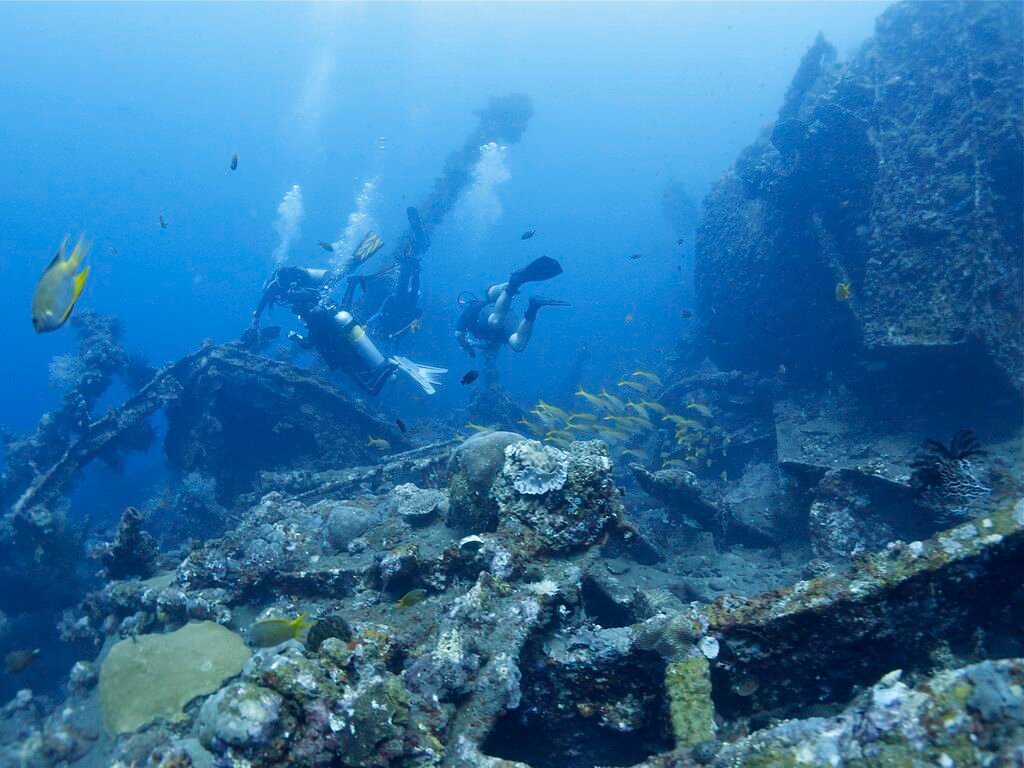
The ship was torpedoed by a Japanese submarine in January 1942 and beached in Tulamben. It sat on the beach for two decades until the 1963 eruption of Mount Agung pushed it into the sea, where it now rests on its side at depths ranging from 5 to 30 meters. The hull is blanketed in coral, sponges, and sea fans, and the surrounding waters teem with life — schools of trevally, bumphead parrotfish, barracuda, and an incredible range of macro subjects including leaf scorpionfish, ghost pipefish, and nudibranchs.
The wreck is suitable for all certification levels, though deeper penetration requires Advanced Open Water. The best strategy is to dive early — arriving at sunrise around 6:00 AM gets you on the wreck before the day-trip crowds from south Bali arrive around 9–10 AM. Nearly every dive school in Amed offers daily trips to Tulamben with transport included.
💡 Pro tip: If you’re staying in Amed, ask your dive school about a sunrise dive on the Liberty. Most charge only a small premium, and you’ll have the wreck almost entirely to yourself in stunning early-morning light. Night dives on the Liberty are equally magical — nocturnal hunters like lionfish emerge, and the coral polyps open to feed.
Amed Diving Prices (2026)
Amed is one of the most affordable places in the world to dive and earn PADI certification. Prices below reflect the general range across established dive schools in 2026. Most include full equipment rental, guide, transport to sites, snacks, water, and applicable taxes.
Fun Dives (Certified Divers)
| Service | Price Range (IDR) | Approx. USD |
|---|---|---|
| Single fun dive (Amed sites) | 400,000 – 850,000 | $25 – $55 |
| 2-tank morning dive | 750,000 – 1,500,000 | $47 – $95 |
| Night dive | 500,000 – 950,000 | $32 – $60 |
| USAT Liberty day trip (2 dives) | 900,000 – 1,600,000 | $57 – $100 |
| Multi-day packages (per dive) | 350,000 – 700,000 | $22 – $44 |
PADI Courses
| Course | Duration | Price Range (IDR) | Approx. USD |
|---|---|---|---|
| Discover Scuba Diving | Half day | 950,000 – 1,740,000 | $60 – $110 |
| PADI Open Water Diver | 3–4 days | 4,250,000 – 6,150,000 | $265 – $385 |
| PADI Advanced Open Water | 2 days | 3,950,000 – 5,200,000 | $250 – $325 |
| PADI Rescue Diver + EFR | 3 days | 5,500,000 – 7,950,000 | $345 – $500 |
| PADI Divemaster | 2–3 weeks | 12,000,000 – 18,000,000 | $750 – $1,125 |
⚠️ What’s included matters more than the sticker price. Cheaper quotes sometimes exclude PADI certification fees, manual costs, or transport. Always confirm what’s included before booking. Some schools bundle free accommodation with courses — which can represent significant savings.
💡 Budget tip: Several dive schools in Amed offer one free night of accommodation per diving day for backpackers, and dive-and-stay packages that bring the overall cost down substantially. If you’re planning multiple days of diving, always ask about package rates.
Best Dive Schools in Amed
Amed has a well-established dive scene with a mix of long-running PADI resorts and smaller independent operations. Here are some of the most reputable options, based on their track record, safety standards, and diver reviews.
Amed White Sand Divers ★ PADI 5 Star Resort
One of Amed’s most established operations, located on Lipah Beach. Known for small group sizes (typically 2:1 diver-to-guide ratio, maximum 3:1), multilingual instructors teaching in English, French, German, Spanish, and Indonesian, and a strong safety record. They partner with eight local hotels for accommodation packages and cater well to both fun divers and those seeking advanced specialties including tec diving.
Highlights: Small group ratios • 5 languages • Tec diving available • Free hotel pickup
Bali Reef Divers ★ PADI 5 Star Center
Operating from both Amed and Tulamben, this dive center is well-positioned for divers who want easy access to the USAT Liberty as well as Amed’s sites. They run a full schedule of PADI courses and offer dive-and-accommodation packages at competitive rates. Their Tulamben location also has budget dorm rooms for solo travellers and backpackers.
Highlights: Amed + Tulamben bases • Budget accommodation • Full PADI course range • Equipment included
Amed Dive Center
Operating since 2002 in cooperation with Hotel Uyah Amed & Spa Resort. A registered PADI Dive Resort (No. 6771) with a strong focus on environmental sustainability — they run an artificial reef project where visitors can contribute by creating named sculptures that are placed underwater. They offer both PADI and SSI certifications and are popular with divers who appreciate an eco-conscious approach.
Highlights: Eco reef project • PADI + SSI courses • Hotel partnership • Est. 2002
Fresh Fins Diving
A newer addition to the Amed scene, located in a striking bamboo structure on Jemeluk Bay with a large swimming pool for training. Their team has deep local expertise around Amed and Tulamben and they’re known for helping divers find hidden-gem sites and rare marine species like pygmy seahorses. They also offer day trips to Nusa Penida for certified divers looking for manta rays.
Highlights: Jemeluk Bay location • Pool on-site • Nusa Penida trips • Bamboo eco-design
Two Fish Divers Amed ★ PADI 5 Star Center
Part of a respected multi-location dive operation also present in Lembongan. They maintain a maximum four divers per guide, run a loyalty points system, and offer structured dive-and-stay packages at varying accommodation levels. They have Nitrox available for certified enriched-air divers and a full equipment inventory. A solid choice for those planning a multi-day diving holiday.
Highlights: Max 4:1 ratio • Nitrox available • Loyalty program • Dive+stay packages
Dive Concepts Amed
A well-regarded centre known for competitive pricing and a wide selection of dive sites — their site list extends from Ghost Bay and Gili Selang all the way through Jemeluk, Bunutan, the Pyramids, and the Japanese Wreck. They offer fun dive packages in sets of 3, 5, or 7, and their pricing is among the most affordable in Amed, making them a favourite with budget travellers.
Highlights: Budget-friendly • Wide site selection • Multi-dive packages • Day trip snorkelling
Best Time of Year to Dive in Amed
Amed is a year-round diving destination, but conditions vary with the seasons. Here’s what to expect.
🌞 Dry Season (April – October)
The best overall conditions. Visibility regularly reaches 20–30 meters, seas are calm, and sunny skies are nearly guaranteed. July through September is peak tourist season, so book dive schools and accommodation in advance. Water temperatures stay warm at 27–29°C.
🌧️ Wet Season (November – March)
Rain typically falls at night or in short afternoon bursts and rarely affects underwater conditions significantly. Visibility drops slightly (15–20 m on average) but the reefs are quieter, prices are lower, and you’ll have more personal attention from dive guides. Plankton-rich waters during this period can attract larger marine life.
💡 Sweet spot: October and November are widely considered the optimal months — the dry season has calmed the seas, visibility is excellent, crowds have thinned after the July–September peak, and the nutrient-rich transition period can bring interesting marine encounters.
Is Amed Good for Beginner Divers?
Amed is one of the best places in Southeast Asia to learn to dive, and here’s why: the combination of calm, warm, shallow water with beautiful marine life right at the surface means beginners get a genuinely rewarding experience from their very first dive — not just a training exercise in murky conditions.
Jemeluk Bay and Lipah Bay both offer protected, current-free zones where Discover Scuba Diving experiences and Open Water training dives take place. The Japanese Wreck at just 6–12 meters deep is accessible to DSD participants. Many instructors in Amed specialize specifically in first-time divers and the teaching ratio is typically 1:1 or 2:1 — far more personal than what you’d get at a high-volume dive shop in Kuta or Sanur.
The village atmosphere also helps. Amed is free of the traffic, noise, and party scene of south Bali, which makes the process of learning to dive more relaxed. You can walk from your guesthouse to the dive shop, train in a pool or calm bay, and be on a reef within minutes.
What to Bring & Practical Tips
Most dive schools in Amed provide a full set of rental equipment — BCD, regulator, wetsuit, mask, fins, and tanks. However, there are a few things worth knowing before you arrive.
Bring With You:
- Reef-safe sunscreen (critical — regular sunscreen damages coral)
- Dive booties or reef shoes — Amed’s beaches are rocky black sand and pebbles, not soft sand
- A 3mm wetsuit is standard here, but if you run cold, ask your school about 5mm availability
- Underwater camera or GoPro — you’ll want one
- Your certification card and logbook if you’re already certified
Good to Know:
- ATMs exist in Amed but can run out of cash, so bring enough rupiah for your trip or pay dive schools by card where accepted
- Most shops schedule 2 morning dives departing around 8 AM, with afternoon and night dives available
- Allow 24 hours after your last dive before flying
- Bring motion sickness tablets if you’re prone — the 3-hour drive from south Bali is winding
How to Get to Amed
Amed is located on Bali’s northeast coast in the Karangasem regency, approximately 2.5 to 3 hours by car from Ngurah Rai International Airport (DPS) or the south Bali tourist areas. The drive follows scenic mountain roads through rice terraces and past views of Mount Agung.
The most common options are:
- Private driver: Around IDR 500,000–700,000 one way from the airport
- Shuttle service: Booked through your hotel or dive school
- Scooter rental: IDR 70,000–100,000 per day once in Amed
Many dive schools include airport transfers as part of dive-and-stay packages, so always check before arranging your own transport. There’s no public bus service to Amed, and ride-hailing apps have limited coverage in this part of Bali.
Once in Amed, a scooter is the easiest way to get around the coast. The main coastal road connecting the bays and dive sites is straightforward and scenic.
FAQ
How much does scuba diving cost in Amed, Bali?
Fun dives typically cost IDR 400,000–850,000 per dive (roughly USD 25–55) including full equipment. A PADI Open Water course ranges from IDR 4,250,000 to 6,150,000 (USD 265–385), and Discover Scuba Diving experiences start from around IDR 950,000 (USD 60). Prices vary by school and whether accommodation is bundled.
What is the best time of year to dive in Amed?
April to October (dry season) offers the best visibility and calmest conditions. October–November is the sweet spot for optimal water clarity with fewer crowds. That said, Amed is diveable year-round — wet-season rain rarely impacts underwater conditions.
Is Amed good for beginner divers?
Excellent. Sites like Jemeluk Bay and Lipah Bay provide calm, shallow water ideal for training. Many dive schools specialize in first-time divers with low instructor-to-student ratios.
What marine life can I see diving in Amed?
Amed is within the Coral Triangle — home to over 76% of the world’s coral species, 3,000+ fish species, and six of seven turtle species. Divers regularly encounter turtles, reef sharks, barracuda, trevally, nudibranchs, pygmy seahorses, ghost pipefish, frogfish, and garden eels.
How far is Amed from the airport?
Approximately 2.5–3 hours by car from Ngurah Rai International Airport (DPS). Private drivers and dive school transfers are the most common transport options.
Do I need to bring my own equipment?
No. All established dive schools in Amed provide full equipment rental (typically included in the dive price). Bringing reef shoes or dive booties is recommended for the rocky beach entries.
Can I dive the USAT Liberty wreck from Amed?
Yes. Tulamben is only a 20–30 minute drive from Amed, and nearly every dive school offers daily trips. Many divers base themselves in Amed and day-trip to the Liberty for 1–2 dives.
What water temperature can I expect?
Water temperatures in Amed range from 27–29°C year-round. A 3mm shorty wetsuit is standard, though thermoclines on deeper dives can be noticeably cooler.
Scuba Diving in Amed, Bali — The Complete Guide
Prices and availability are subject to change. Always confirm directly with dive schools before booking. Last updated May 2026.

Just desire to say your article is as astounding. The clarity in your post is just nice and i can assume you are an expert on this subject. Well with your permission allow me to grab your RSS feed to keep up to date with forthcoming post. Thanks a million and please keep up the gratifying work.
[314581]supplies professional anti-violence equipments and solutions for the whole world with strong and perfect production capacity. anti-violence.org
Cảm ơn thông tin bổ ích. Nếu bạn quan tâm du học Hàn Quốc, Letco chuyên tư vấn lộ trình, chọn trường và xin visa với tỷ lệ đậu cao. Xem chi tiết tại letco.vn.
This actually ties into something. For anyone on the market, the smartest move was ditching the scattergun approach — I went with https://jsbv.www-duoduo28.com/. It shows local and remote roles with filters that actually work.
Not strictly on-topic, but useful. If you open https://nqll.zfxetytwl.top/, you’ll see a clean, no-nonsense job board — both local and remote work you can dig through without the clutter.
Best platform I have used in the Philippines so far. The variety of games is impressive and the payouts are fair. Give phbcgame a try, you won’t regret it.
Thanks, this cleared things up. More on the subject at gigsfield.shop for those curious.
Really impressed with the interface here. Everything is easy to navigate and the rewards are actually fair. I’ve been playing for a week and it’s been a blast. Visit idplanetliga
The graphics and sounds make the whole experience so immersive. It feels like a real casino right in my room. Love richjili777!
The mobile app is a game changer. I can play whenever I have a few spare minutes and the connection is always stable. Best way to access fb777applogin for sure.
The bonus offers are actually worth it compared to other sites I have used. The slots are fair and the excitement is real. Give cwdbetslot a go if you love slots.
Login is always fast and secure. I don’t have to worry about my account getting locked out. jiliflogin makes the whole process stress free.
[710780]supplies professional anti-violence equipments and solutions for the whole world with strong and perfect production capacity. anti-violence.org
Quick access and no fuss. I love that I can jump straight into my favorite games without any annoying glitches. Very reliable platform. 291jililogin
The bonuses at jili90club are actually decent compared to other places. I had a great run last night and the withdrawal process was surprisingly quick. Great experience so far!
I really appreciate the transparency of this platform. Winning feels fair and the withdrawals are processed without any drama. Five stars for krmawinbet
Super reliable platform with a great selection of slots. I appreciate how transparent everything is with the withdrawals. Love phjili999
If you love slots, this is the place to be. The jackpots are thrilling and the loading times are almost zero. Get into the game at phjilislotph.
The APK is very stable and works perfectly on my Android phone. Much better than playing in the browser. Download bd1333betapk now.
I’ve been looking for a stable platform and this one really delivers. The interface is smooth and the payouts are fast. Definitely check out winpkr2 if you want a reliable experience.
The app version is just fantastic. I can play on the go without any glitches. If you prefer mobile gaming, noblejiliapp is a must have.
Installation was a breeze and the app works perfectly. No annoying bugs or crashes during my sessions. Thanks to 3777bdtapk for the great service.
I love how everything is organized on this site. It makes finding my favorite games so much easier. A solid five stars for playtimept.
Honestly the best experience I have had in a long time. The rewards are fair and the gameplay is super addictive. Big fan of idminion178
Finally found a platform that actually pays out fast. The game selection is top notch and the bonuses are legit. Check out ph50jili if you want a real gaming experience.
I appreciate the transparency and the fair odds on this platform. It makes the betting experience much more enjoyable. Definitely trust 45555bet.
This site is very user friendly even for beginners. I appreciate the clear layout and the fast loading times. 998jilicom is definitely worth checking out.
This app has completely changed how I play. The rewards are generous and the community is very welcoming. Give paldopanaloapp a try
I hit a decent jackpot here last week and the money hit my account almost instantly. This is where the real action is. Visit ph777richjili
I’ve tried a few platforms lately, but this one feels the most stable. Great games and a very friendly vibe over at vn123winvn.
Honestly one of the most reliable sites for Jili fans. The graphics are stunning and the win rate feels fair. Glad I found ph5jili.
A hidden gem for sure. I love the variety of games they offer and the community feels very welcoming. Having a great time at inyy567games
I’ve been trying a few different sites this month and this one really stands out. Great variety of games and the customer support is actually helpful. Check out vnmh66 if you want a stress-free experience.
Finally found a platform that doesn’t lag during peak hours. The user experience is top notch and the support team is very helpful. Give br616bet1 a try.
Simple, clean, and effective. I don’t like cluttered websites and this one gets straight to the point. g9999 is perfect for players who hate unnecessary noise.
Honestly one of the best betting experiences I have had this year. The odds are competitive and the bonuses are actually useful. Check out bd007bet for a great time.
Best betting experience I have had recently. The interface is clean and the betting options are quite comprehensive. I feel very secure playing here. Check out vn989bet.
Really loving the interface here. The loading speed is fast and the games are super smooth. Definitely my new favorite spot to hang out. Check out dreamjili2login
Downloading the app was literally a one click process and it runs so smoothly without any lag. I appreciate how the developers keep updating the features based on player feedback. The mobile interface is clean and makes navigating between games a total breeze. ap168appdownload
Best experience I’ve had in a while. The interface is super friendly and the payouts are fair. phplus777asia is becoming my go-to platform for daily entertainment.
Just a simple and clean site that does exactly what it promises. I feel like my luck has actually improved since I started playing here. Give 7luck a go
I love how easy it is to navigate through the different categories. It is very intuitive and doesn’t feel cluttered. Great job by the idbrojp team.
If you are looking for a professional casino experience from home this is it. The graphics are top notch and the gameplay is fair. Visit betpkonlinecasino today.
Super impressed with the game variety here. Everything loads quickly and I haven’t had any lag issues. Check out vnnk8812 if you want a great gaming experience.
Solid platform with great security. I feel safe depositing here and the gaming options are simply endless. Check it out! pk888starz
I am absolutely loving the variety of games here! The graphics are top-notch and the payouts feel fair. It is my new favorite spot to unwind after work. Highly recommend inyoyoslots to all slot fans.
If you are looking for a platform that actually pays out on time then this is it. Everything is transparent and fair. Big wins at br333win!
Honestly the best experience I’ve had recently. The games load fast and the payouts are legit. Definitely check out ph65jili if you want some real action!
Super friendly community and great promotions for new members. I feel lucky every time I log in here. Visit 85ph777 for some amazing rewards.
Very interesting details you have observed, thanks for posting.
The game selection is huge and the graphics are crisp. It feels like a premium experience from start to finish. Love spending my free time on phlodibet999.
Very professional setup and the withdrawal process is transparent. No hidden fees which is a huge plus. Cheers to idmonata189.
The variety of games here is impressive. I had a great run last night and the customer support was super helpful when I had a question about my bonus. Give xx88a a try!
Top notch service and a huge variety of betting options. It is hard to find a place this consistent these days. Highly suggest giving brbet917cc a try.
Love how intuitive the layout is. Even for a beginner like me, it was easy to get started and find the best games. phssbet77 is definitely worth the visit.
Had a great run last night! The winning streaks are real on this platform. br5win5 is officially my new favorite spot.
The best place to bet if you are looking for fairness and speed. I had a huge win last weekend and the withdrawal was instant. Love phmegabet
Really impressed with the bonuses they offer for new members. It gave me a great head start to explore the games. Give bdppc88 a shot!
The VIP treatment here is real. I feel valued as a player and the rewards are generous. If you want a premium experience check out idrpvip4.
Really impressed with the user interface. Everything is so easy to find and the loading speed is top notch. Love phaaajili7!
Quick, safe, and efficient. I was worried about the APK but this site is trustworthy and the file works perfectly. Grab your copy at ph143downloadapk.
Downloaded the app and immediately fell in love with how streamlined everything is. Navigating between sports and casino is effortless and the odds are honestly competitive. I had a quick question about a promotion and got a detailed answer in minutes. This is exactly how an online betting platform should feel. 818betapp
This platform feels very professional and secure. I feel safe playing my favorite games here. Go to br777brazino and see for yourself.
I have tried a few platforms lately but this one really stands out. The interface is smooth and the payouts are surprisingly fast. Definitely worth a try for anyone looking for a reliable spot. Check out kr855win for a great experience.
Finally found a place that understands what players really need. The mobile interface is so clean and loading times are basically instant. I love how they keep adding fresh promotions that actually feel worth claiming. It is like having a cozy casino lounge right in my pocket every day. 6333bat
Really impressed with the user experience here. Everything is laid out perfectly and the game loading times are minimal. Check it out at bd99g777
I’ve been trying a few different sites lately and this one really stands out. The interface is smooth and the payouts are surprisingly fast. Definitely worth a check vnnn88game
Honestly the game variety here is insane. I spent the whole weekend exploring different rooms and didn’t get bored once. Highly recommend yono789game for anyone looking for real excitement.
If you love slots you cannot miss this one. The hit rate seems much better here than on other platforms I have used. Give balislot88 a try.
I’ve tried a few different sites but this one actually feels fair and exciting. The payouts are decent and the games are addictive. Love m555game.
Had a lucky streak here last night! The system is transparent and the wins feel legit. Can’t wait to go back to pk999win
Fast withdrawals and a very clean layout. It makes the whole experience much more enjoyable without any unnecessary clutter. Love bdj444.
I’ve been looking for a smooth app experience and this one delivers. The loading speed is impressive and the interface is very intuitive. Highly recommend 5777betloginapp for anyone who hates lagging.
Great local experience and the payment methods are very flexible. It feels like they actually understand what players here want. Highly suggest pisokingph.
Really impressed with the variety of games here. It feels very intuitive and the loading times are super fast. Glad I found d188com today.
Great vibes and even better rewards. I really appreciate how straightforward the rules are here. Definitely visit bdm444 for some quality entertainment.
Very impressive system and a very smooth user experience. Everything is well organized and easy to navigate. Five stars for senja128login
The energy here is amazing and the community feels welcoming. I am really enjoying the current promotions. Shoutout to poneclubbuzz for the great setup.
Simple, clean, and effective. I don’t like cluttered websites and this one gets straight to the point. g9999 is perfect for players who hate unnecessary noise.
Check new information here
Best slot experience I have had in the PH lately. The graphics are crisp and the wins feel genuine. Highly recommend jilipark22slot to all my gaming buddies.
Fast access and a great collection of games. I spend a lot of my free time here because it is just so addictive. Check out senopati4login.
Great platform with a very intuitive layout. I love how easy it is to navigate through the different sections. asiabetlogin makes everything so much simpler for the user.
This place has a great selection of games and the rewards are actually reachable. It is my go to spot for some weekend fun. Check out bd3777bdt.
The promotions are legit and the withdrawal process is straightforward. vnz188 is a solid choice for any player.
I’ve been looking for a reliable spot like this for a while. The interface is super smooth and the payouts are fast. Definitely recommending pkuk999 to my mates!
The download speed is impressive and the installation was a breeze. No weird errors or glitches. 01gamedownload is my new go-to spot.
I’ve suggested this site to all my friends. The odds are fair and the gameplay is exciting. idpasar123 is definitely my new favorite.
Finally found a login page that doesn’t glitch out. The process is straightforward and it gets me straight to the games. Great job on okbetcomlogin.
A solid platform with a very fair system. I appreciate the transparency and the wide range of options available. Love 76nbetlogin.